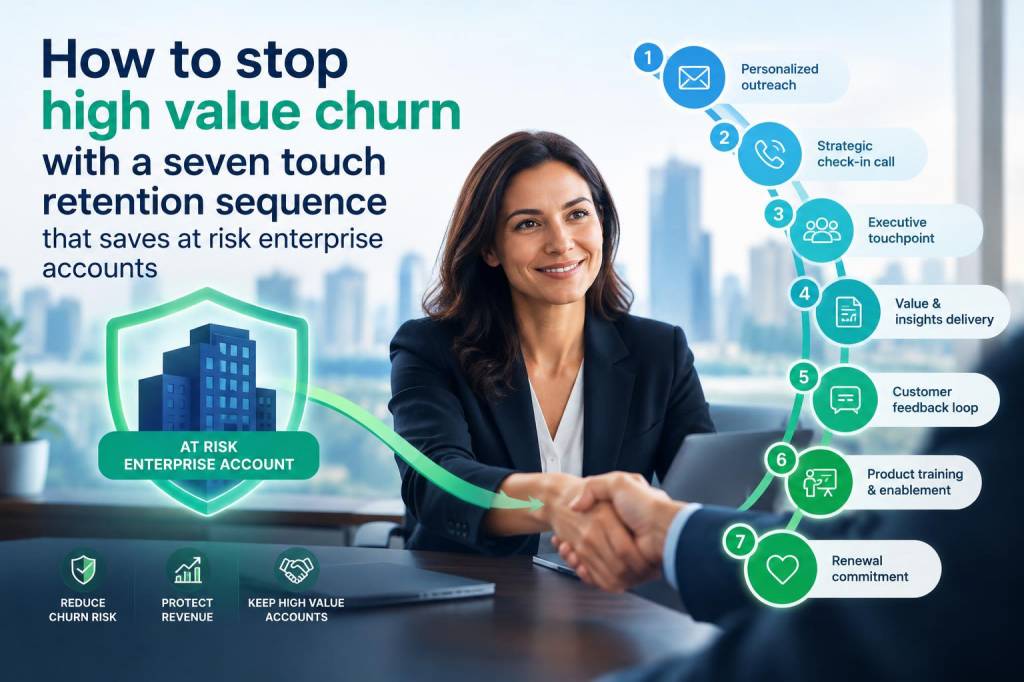
I’ve lost more than one high-value account in my career and each time the experience pushed me to build a repeatable way to rescue at-risk enterprise customers. Over the last decade I refined a seven-touch retention sequence that combines data signals, human outreach and value-first work to stop churn before it becomes inevitable. Below I share the exact sequence, the triggers I use to identify “at-risk,” scripts and playbook elements you can copy into Salesforce, HubSpot or Gainsight, and the KPIs I track so you know whether the sequence is working.
Why a seven-touch sequence and not just emails?
Because enterprise churn is rarely solved by a single message. It’s a process: signals surface a problem, context reveals the cause, and the right combination of product fixes, contract flexibility and executive attention wins the account back. I designed the seven touches to move from low-effort detection to high-impact intervention — pacing outreach so you escalate only when earlier steps don’t work.
How I identify at-risk enterprise accounts
Before starting outreach, you need reliable signals. I combine quantitative triggers with qualitative inputs.
Feed these into a simple scoring model (weighted) and set a threshold for “at-risk.” I run this in Gainsight or a custom report in Salesforce so CSMs get real-time lists.
The seven-touch retention sequence (playbook)
Each touch has a clear objective, owner and acceptable SLA. The sequence typically unfolds over 14–21 days depending on risk level.
| Touch | Owner | Objective | Channel | Timing |
|---|---|---|---|---|
| 1 — Signal confirmation | CSM | Validate the data; quick check-in | Email + in-app message | Day 0 |
| 2 — Low-friction value reminder | CSM | Deliver immediate value (how-to, tip, ROI datapoint) | Email + short video | Day 2 |
| 3 — Discovery call | CSM | Surface root causes and blockers | 15–30 min call | Day 4–6 |
| 4 — Rapid remediation plan | CSM + Product/Support | Commit to fixes and timelines | Document + shared Trello/Jira | Day 7–9 |
| 5 — Exec outreach | Customer Success Director | Show escalation and commitment | Email + LinkedIn | Day 10–12 |
| 6 — Implementation assist | Solutions Engineer/Service Team | Hands-on help to remove friction | Co-browsing, demo or onsite | Day 12–16 |
| 7 — Value recapture + close-loop | CSM | Agree KPI improvements and next steps | Call + follow-up summary | Day 18–21 |
Scripts and templates I use
Below are short templates you can drop into your CRM. Keep language human and specific.
Hi [Name],
We noticed [metric] dropped by [x%] over the last [period]. I wanted to check in quickly — is this something you’ve observed on your side? If helpful I can pull a short usage breakdown and suggest one thing to try right away. Are you available for a 10-minute check-in this week?
- 5’ recap of what we see (data)
- 10’ customer perspective / root causes
- 10’ proposed quick actions we can do in 48–72 hours
- 5’ agree owner & timeline
Hi [Executive Name],
I’m [CSD Name], responsible for key accounts at [Company]. [Customer name] is an important partner and we’ve escalated a retention plan due to recent [usage decline/support issues]. I want to personally ensure we deliver results — could we schedule 20 minutes to align on priorities this week? I’ll bring the remediation commitments we’ve made.
What “value-first” work looks like
In early touches you should deliver something tangible — not a promise. Examples:
These small wins re-establish trust and buy time for product fixes or contractual negotiations.
How to escalate without burning the relationship
Escalation must signal care, not threat. I train teams to:
Key metrics to track effectiveness
Track both process and outcome metrics weekly:
Operational tips for scaling the sequence
To run this across many enterprise accounts without chaos:
I’ve used this sequence with startups and mid-market enterprises across the UK and Europe. When we followed the cadence — pairing immediate small wins with accountable remediation and executive attention — retention improved quickly and renewals followed. If you want, I can turn this into a copy/paste playbook for Salesforce or HubSpot, including task templates and email sequences you can drop in and start using this week.