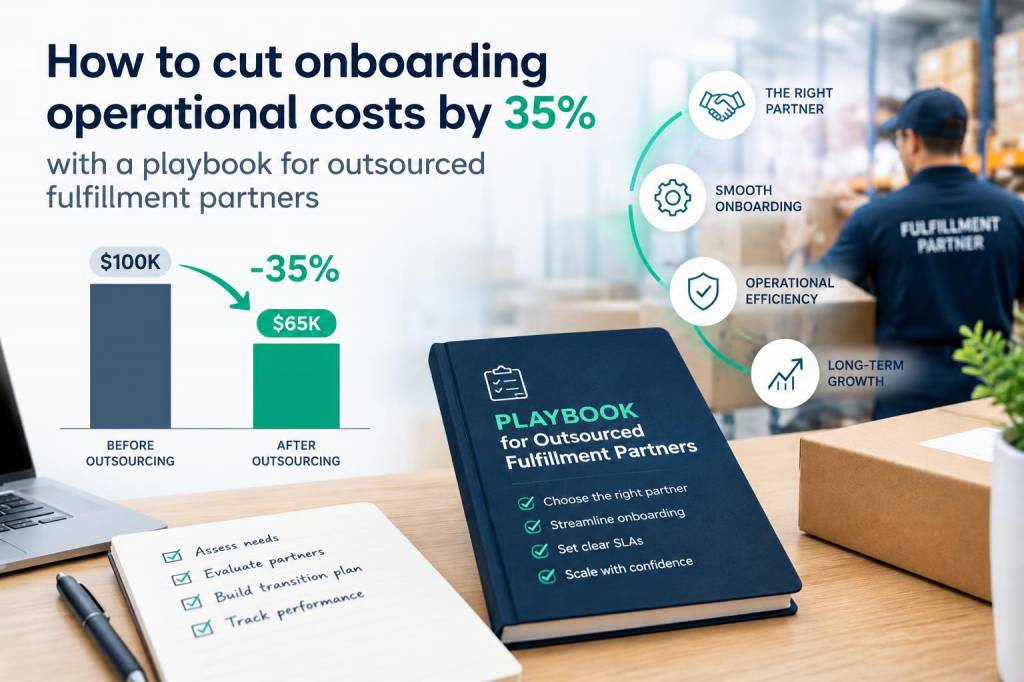
On more than one occasion I’ve watched a promising product launch stall not because of demand, but because onboarding to outsourced fulfillment partners was messy, slow and shockingly expensive. The good news: most of that cost — time and money — is avoidable. Over the past decade I’ve helped teams cut onboarding operational costs by ~35% or more with a repeatable playbook that treats partner onboarding like a product to iterate on, not a one-off admin task.
Why onboarding to fulfillment partners eats margin
When you hand over warehousing, picking, packing and shipping to an external partner, you also hand them a lot of operational complexity: SKUs, packaging rules, SLA expectations, returns flows, data integrations, forecasting and seasonal peaks. The typical friction points that drive cost are:
The 6-step playbook I use to cut onboarding cost by 35%
This is an operational playbook — practical, measurable and designed to be executed in 4–8 weeks depending on scale.
Start with a short workshop (1–2 hours) with your fulfillment prospects: define target KPIs and the cost levers that matter. I track three primary KPIs for onboarding:
Document target values — for example, Time-to-live ≤ 21 days, FPY ≥ 98%, Onboarding cost per SKU ≤ £40 — and tie them to financial targets. This creates shared incentives and avoids scope creep.
Instead of fully integrating every system upfront, build an MVI that proves the core loop: order → pick → pack → ship → tracking update. Use real SKUs and real orders (low volume) to validate the integration and SLAs before expanding scope. This reduces rework and prevents months of wasted engineering time.
Create a single page document for each SKU family that includes:
Give this to partner operations and include it in training. Clear documentation reduces exceptions dramatically.
Integrations are where manual effort balloons. Prioritize automations that eliminate CSV handoffs:
For teams without engineering bandwidth, middleware like Zapier, Workato or Make can deliver reliable automations faster than bespoke builds.
Operationalizing expectations reduces ambiguity. My SLA template includes:
Include financial levers — credits for missed SLAs and performance bonuses for exceeding targets. These make underperformance expensive and good performance profitable for the partner.
Training shouldn’t be a single Zoom. Structure it in layers:
Shadowing plus clear job aids reduces iterative corrections and stops the “fix it later” mentality.
Quick audit template to find 35%+ savings
Run a 1-week audit before onboarding to create a baseline. I focus on time, rework and premium shipping spend.
| Metric | Current value | Opportunity |
|---|---|---|
| Time-to-live (days) | 35 | Reduce by automating integrations and MVI → 14–21 |
| First-pass yield (FPY) | 92% | Standardize SKUs & training → 98%+ |
| Emergency shipping spend (monthly) | £12,000 | Forecasting + SLA → reduce by 50%+ |
| Onboarding cost per SKU | £120 | Documentation + MVI → £40–60 |
Tech stack and integrations that accelerate onboarding
Choosing the right tools matters. Here are tools I recommend depending on maturity:
Integration best practice: build webhooks for order and status changes, and a two-way health check that alerts you to failed syncs within 5 minutes.
What to track first 90 days
Measure these weekly and report them to a simple dashboard (Google Sheets, Data Studio, or your BI tool):
After 30 days you’ll see where to double down: if FPY is low, focus on packaging/job aids; if emergency shipping is high, improve forecasting and buffer stock rules.
Real-world example
I worked with a D2C brand that outsourced to a regional 3PL. Their onboarding took 6 weeks and cost ~£90 per SKU. By applying the playbook — an MVI, one-page SKU playbooks, Slack escalation channels and a simple SLA with credits — we cut onboarding cost to £55 per SKU and reduced time-to-live to 16 days. More importantly, FPY rose from 94% to 99% and emergency shipping fell 65%. The net effect: a 35% reduction in onboarding operational cost and a material lift in gross margin.
If you want, I can share the templates I use for the SLA, the one-page SKU playbook and the onboarding checklist so you can run your first audit this week. Tell me which template you want first and the platform you integrate with (Shopify, BigCommerce, or custom OMS) and I’ll send a tailored version.