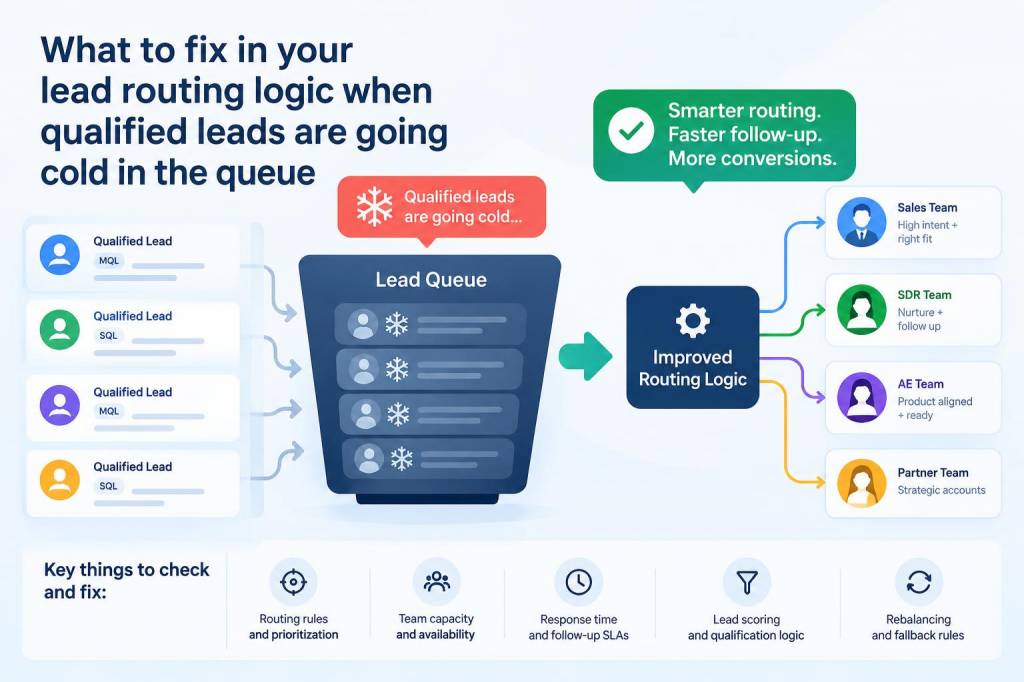
I have seen this problem surface in more than one growth team: qualified leads enter the queue with strong intent, then sit long enough for interest to cool, reply rates to drop, and revenue to leak away. At first, people blame sales reps for being slow. In practice, the real issue is usually deeper. Lead routing logic is often built for convenience, not for response speed, priority, or accountability.
When a qualified lead goes cold in the queue, I do not start by asking, “Who failed to follow up?” I start by asking, “What in the routing system made a good lead wait?” That question usually exposes structural problems: unclear ownership, poor segmentation, too many handoff layers, weak SLA enforcement, and rules that look elegant on paper but fail in real time.
When routing logic creates delay instead of momentum
In many organizations, routing logic is designed to be fair before it is designed to be fast. Leads are distributed evenly across reps, assigned by geography, or passed through a scoring threshold before anyone can touch them. Those rules may feel disciplined, but they can create friction at the exact moment speed matters most.
A lead can be “qualified” in a CRM and still be effectively stranded. Maybe it enters a round-robin queue behind several other leads. Maybe the system waits for enrichment, lead scoring, or territory validation before assignment. Maybe it is assigned to a rep who is in meetings all day, on leave, or already overloaded. By the time first outreach happens, the window of intent has narrowed.
I usually look for one simple pattern: if a lead becomes less likely to convert because of the time it spent waiting, then the routing logic is not just operationally inefficient. It is hurting conversion economics.
What I check first in the queue
When I audit lead routing, I focus on a few practical failure points before touching any complex automation.
- Assignment latency: How long does it take from qualification to first human ownership?
- Queue depth: How many leads are waiting before a rep sees them?
- Lead aging: At what age do reply rates, meeting rates, or close rates begin to fall?
- Ownership clarity: Is one person clearly responsible, or does the lead bounce between teams?
- Routing exceptions: Are there too many rules that push leads into manual review?
- Capacity checks: Does the system know whether the assigned rep can respond quickly?
These are operational questions, not just sales questions. A queue that grows too fast or routes too slowly is a systems problem. If I can measure the delay, I can usually fix it.
Common logic flaws that make qualified leads go cold
One of the most common mistakes is using a routing model that assumes all qualified leads are equally urgent. They are not. A high-intent demo request from a target account does not deserve the same treatment as a low-engagement content download that barely crossed a scoring threshold. If both flow into the same queue with equal priority, the urgent lead may wait behind weaker opportunities.
Another issue is over-automation. Teams sometimes add too many rules to protect against bad assignments: company size filters, region filters, product line filters, language filters, account ownership filters, and score gates. Each rule may seem reasonable. Together, they create delay and confusion. I have seen systems where a lead had to pass through three different routing layers before anyone could call it.
Capacity is another blind spot. Many routing systems know who should receive a lead, but not whether that person can act on it right now. If a rep already has a full queue, routing another lead to that same person may satisfy a rule while defeating the business goal. A good routing engine should consider workload, not only territory or hierarchy.
There is also the hidden problem of silent aging. Some teams assume a lead is fine as long as it has not been closed or rejected. But silence is a decision too. If a lead sits untouched for hours or days, the queue has already failed, even if no one marked it as a problem.
What I change in the routing logic
My first priority is always speed to ownership. I want qualified leads assigned to a clear owner as fast as possible, with as few intermediate steps as possible. If a lead needs enrichment, scoring, and validation, I ask which of those tasks truly must happen before assignment and which can happen after.
I also separate initial ownership from final distribution. In some systems, it helps to route immediately to a fast-response intake rep, then reassign later based on fit, account tier, or product need. That may sound less elegant, but it often protects response time and reduces lost opportunities.
Another adjustment I make is to introduce priority logic based on intent. Not every qualified lead should enter the same queue. I like to define a priority layer that considers:
- form type or conversion source
- company fit
- page behavior or product interest
- engagement recency
- account status
- existing relationship or prior touchpoints
If a lead shows strong buying signals, it should rise above generic qualification rules. I want the routing logic to reflect commercial reality, not only data cleanliness.
I also revisit ownership balance. Even a perfect routing model fails if one rep receives too many leads while another has room to respond quickly. I prefer routing logic that can shift leads based on capacity thresholds, not just static assignment rules. If one queue is under pressure, the system should be able to redirect fast.
What I measure after the fix
When I change routing logic, I do not rely on gut feeling to decide whether it worked. I watch a small set of operational metrics that show whether the queue is healthier.
| Metric | Why it matters | What I want to see |
|---|---|---|
| Time to first assignment | Shows how quickly a lead gets ownership | Minutes, not hours |
| Time to first contact | Measures actual follow-up speed | Short and consistent |
| Queue age at contact | Reveals how long leads wait before outreach | Low median age |
| Reply rate by age bucket | Shows when intent starts to fade | Better performance on younger leads |
| Conversion rate by routing path | Identifies which rules produce better outcomes | Clear winners and losers |
I also compare outcomes by source and by rep capacity. Sometimes a routing change improves response time but shifts too much load to one team. Sometimes it improves fairness but hurts speed. The point is not to create a perfect system in theory. The point is to create a system that consistently turns qualified demand into conversations.
Where teams usually overcomplicate things
I often see teams spend weeks perfecting score thresholds while ignoring basic queue health. They debate whether a lead should be scored 74 or 78, but they do not know whether that lead waited six minutes or six hours. That is backwards.
Another common mistake is building routing around internal org charts instead of customer urgency. Territory rules, named-account rules, and pod structures are useful, but they should not block immediate response. If a lead is hot, I care more about who can respond now than who technically owns the account on paper.
Some teams also overuse manual review. Manual review sounds safe, but it often becomes a parking lot for qualified leads. If a human must approve every exception, the queue slows down and the most valuable leads lose momentum. I prefer clear rules for 80 percent of cases and fast fallback logic for the rest.
And finally, I see teams ignore weekends, time zones, and working hours. A routing system that performs well during office hours may fail completely overnight. If your leads arrive globally, your routing logic must account for local response windows and escalation paths, not just internal staffing schedules.
What a healthier queue looks like in practice
In a healthy system, qualified leads do not sit and wait for someone to remember them. They are assigned quickly, prioritized intelligently, and tracked with enough visibility that delay becomes hard to ignore. The queue feels active, not stagnant.
I like to see a structure where every qualified lead has a visible owner, a visible timer, and a visible next step. That means no mystery handoffs, no unclaimed records sitting overnight without alarms, and no lead eligible for follow-up but blocked by process noise.
It also helps when the routing logic is reviewed as often as campaign performance. Marketing changes source quality. Sales changes capacity. Product changes ideal customer fit. If the routing rules stay frozen while the business changes around them, the queue will slowly drift out of alignment.
For me, the real signal that routing logic is healthy is simple: qualified leads keep moving. They do not stall in a “maybe later” state. They reach a human fast, they get the right kind of attention, and they enter a follow-up motion while intent is still fresh.
When I see leads going cold in the queue, I stop treating it as a follow-up issue and start treating it as a system design issue. That shift changes everything, because once the queue itself is fixed, the sales team is no longer fighting the clock before the conversation even begins.
I keep a close eye on how routing logic handles edge cases too: duplicate records, partner-sourced leads, enterprise accounts with multiple contacts, and inbound leads that match more than one territory rule. Those are the moments when weak logic tends to break. If the queue handles those cases cleanly, the rest of the system usually feels much more stable.
I have found that small routing adjustments can unlock disproportionate gains. A faster fallback rule, a tighter SLA, a smarter priority layer, or a simple capacity check can recover lost opportunities that would otherwise disappear unnoticed. In other words, lead routing is not just an operational detail. It is part of revenue protection.