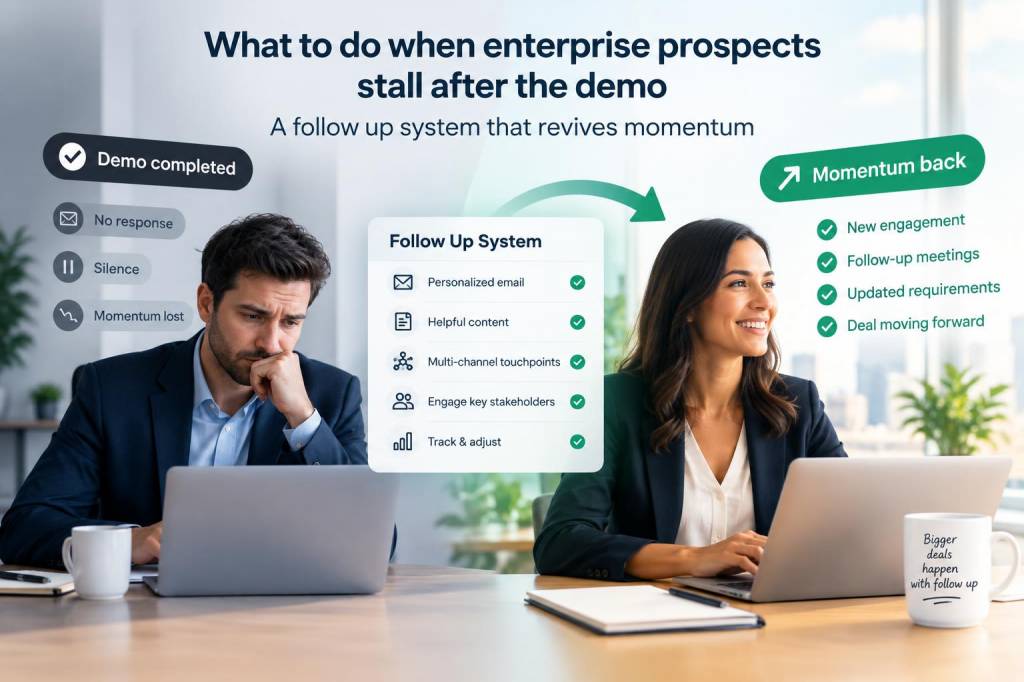
When an enterprise prospect goes quiet after a strong demo, I do not assume interest has disappeared. In my experience, silence usually means friction, not rejection. Something in the buying process has slowed: internal alignment, budget review, technical validation, legal approval, or simple decision fatigue. If I respond with pressure, I usually make things worse. If I respond with structure, I can often revive momentum.
I have learned that post-demo stalls are rarely solved by sending a single “just checking in” email. Enterprise buyers need a follow-up system that reduces effort, clarifies decisions, and creates a safe path forward for everyone involved. When I treat the stall as a process problem instead of a personality problem, my close rate improves and my pipeline becomes more predictable.
What usually causes a stall after a demo
Most deals do not stop because the prospect hated the product. They stop because buying enterprise software or services is complicated. A demo can create excitement, but excitement does not equal consensus. In large accounts, several people must agree before anything moves:
- The user wants a solution that works in daily operations.
- The manager wants proof that the change will not disrupt the team.
- The finance lead wants a clear business case.
- The security or IT team wants risk controlled.
- The executive sponsor wants confidence that the choice supports a strategic priority.
When I see a deal stall, I first ask myself where the buying process broke down. Did I leave the call without a clear next step? Did I fail to identify who else needed to be involved? Did I overload the room with features instead of business outcomes? Did I send too much information and create confusion instead of clarity?
Sometimes the prospect is simply busy. Sometimes they are comparing vendors. Sometimes they liked the demo but were not ready to say yes because they had not yet built an internal case. My job is to uncover the real obstacle without making the buyer feel interrogated.
My first move after the demo
I send a short recap within a few hours, while the conversation is still fresh. I do not write a generic thank-you note. I write a message that proves I listened, confirms the priorities we discussed, and makes the next step easy.
My recap usually includes three parts:
- A short summary of the problems they said matter most.
- The outcomes they want to improve.
- A clear next action with a date attached.
I try to make the next action concrete. For example, instead of saying, “Let me know if you have questions,” I might say, “I will send a proposal with two rollout options tomorrow, and I would like to review it with you on Thursday with anyone else who should weigh in.”
This matters because enterprise buyers often want help moving the deal internally. If I give them something they can forward, present, or compare, I become easier to champion.
My follow-up system when momentum slows
After the initial recap, I use a sequence that balances persistence with usefulness. I do not chase every day. I space my touchpoints so each one adds value instead of noise.
| Day | Move | Goal |
|---|---|---|
| Same day | Send recap email with priorities and next step | Lock in shared understanding |
| Two to three days later | Share a relevant asset: case study, calculator, checklist, or comparison sheet | Help them build internal confidence |
| Five to seven days later | Ask one focused question about the decision process | Expose the actual blocker |
| One week later | Offer a concrete working session with key stakeholders | Reduce friction and accelerate alignment |
| Later touchpoint | Use a break-up or reset note | Surface hidden interest or close the loop professionally |
The important part is not the timing alone. It is the purpose behind each message. Every follow-up should do one of four things: clarify, de-risk, simplify, or advance.
What I send when I want to revive interest
When a prospect has gone quiet, I avoid sending a long emotional email. I keep it practical. I might attach a short customer story that mirrors their situation, or I might send a one-page summary of expected impact. If the buyer mentioned a specific objection during the demo, I address that directly.
For example, if they asked about implementation effort, I will send a rollout plan. If they worried about reporting accuracy, I will share a sample dashboard. If they needed internal approval, I will create a short business case they can copy into their own deck.
I also like to use simple comparison language. I might write, “If your team wants a lighter launch, option A gets you live faster. If your priority is broader coverage, option B includes the additional support we discussed.” This helps the buyer move from vague interest to a real decision.
One of the most effective assets I have used is a mutual action plan. It shows the steps from now until signature, with owners and dates. Enterprise deals often stall because nobody knows what happens next. A mutual action plan removes ambiguity and gives the buyer something tangible to share internally.
Questions I ask when a deal goes quiet
I prefer questions that uncover process, not pressure. A stalled prospect usually responds better to a useful question than to a pushy reminder.
- “What still needs to happen before this can move forward?”
- “Who else needs to weigh in before you can make a decision?”
- “Is there anything missing from my side that would help you build the internal case?”
- “What would make this easier to approve?”
- “Is timing the issue, or is there another concern I should address?”
I only ask one or two at a time. If I ask too many, I create work. If I ask too few, I may miss the real blocker. The tone matters as much as the wording. I want the buyer to feel that I am helping them move forward, not pushing them into an answer.
What I do when the real blocker is hidden
Sometimes the prospect says they are interested, but the deal still does not move. In those cases, I look for signs that the buying process is not fully formed. Maybe no one owns the project internally. Maybe the person I met is enthusiastic but not powerful enough to drive change. Maybe the organization likes the idea but has no urgent reason to act now.
When that happens, I shift from selling a product to helping build a business case. I ask about current costs, wasted time, manual processes, missed revenue, or risk exposure. I want the buyer to connect the purchase to a real operational or financial pain point. Enterprise decisions move faster when the cost of doing nothing becomes visible.
I also pay attention to internal language. If the buyer says, “We like it,” that is not the same as, “We need it.” If they say, “We are exploring,” I know the deal is still early. If they say, “We need to show this to our CFO,” I know exactly what material to provide. I listen for these signals and shape my follow-up accordingly.
What not to do after a stalled demo
I have made some of these mistakes myself, and they rarely help:
- Sending repeated “checking in” messages with no added value.
- Over-explaining the product in an attempt to regain attention.
- Acting offended when the buyer becomes slow.
- Flooding the prospect with every resource I have.
- Assuming silence means disinterest without testing for real objections.
What usually works better is calm consistency. I stay visible, useful, and specific. I respect the pace of enterprise buying while still guiding the process forward. That balance helps me keep dignity in the relationship and control in the pipeline.
A simple message structure I rely on
When I need to re-engage a stalled enterprise prospect, I use a structure that is short, clear, and easy to answer:
Context: a brief reminder of where we left off.
Value: a useful insight, resource, or asset tied to their priorities.
Question: one direct question that advances the process.
Next step: a specific action with a time reference.
An example might look like this: “I was thinking about the rollout concern you raised in our demo. I attached a simple implementation plan based on similar teams we have supported. Would it be useful to review it together on Wednesday so we can confirm whether this matches your internal timeline?”
This kind of note works because it respects the buyer’s time and gives them a reason to reply. It also shows that I am paying attention to what matters to them, not just what I want from the deal.
How I know whether to keep going
Not every stalled prospect deserves unlimited effort. I keep going when I still see engagement, a clear use case, and a realistic path to decision. I slow down when the buyer cannot identify a process, a stakeholder, or a timeline. In those cases, I may leave the door open with one final useful touchpoint and then move attention elsewhere.
That discipline matters. A healthy pipeline is not just about creating opportunities; it is about knowing where to invest energy. When I use a consistent follow-up system, I spend less time guessing and more time moving serious deals forward.
Over time, I have found that stalled enterprise prospects often come back to life when I make the next step obvious, remove unnecessary friction, and keep the conversation rooted in their internal reality. If a demo created interest but not motion, I do not treat silence as the end. I treat it as a signal to bring structure, clarity, and relevance back into the process.