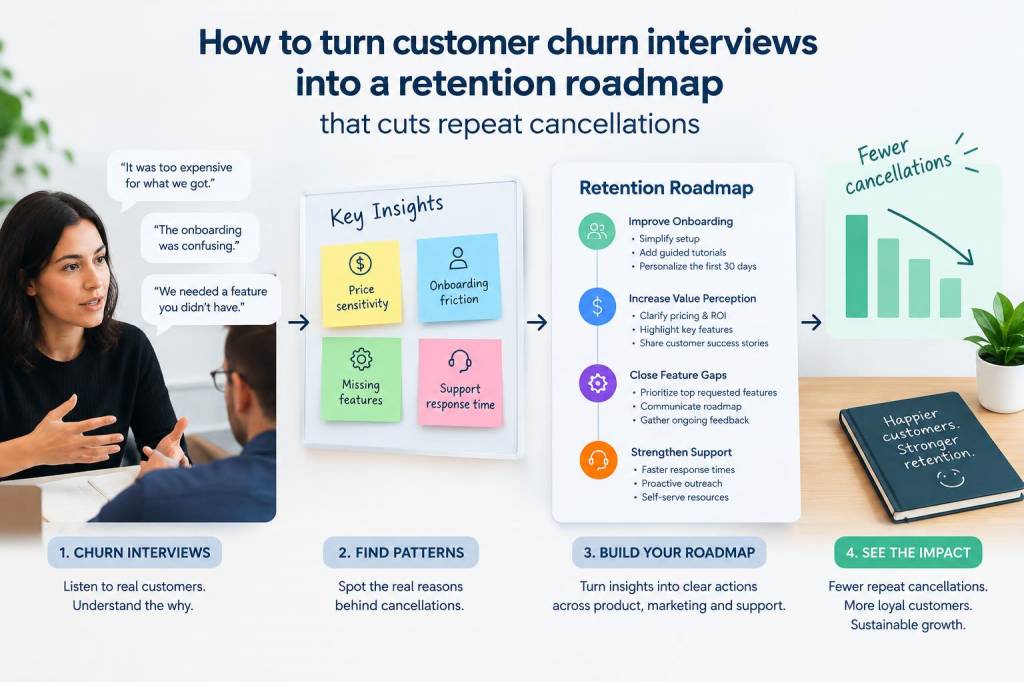
When I hear that a customer has cancelled more than once, I do not treat that as a support problem alone. I treat it as a signal that something in the product, pricing, onboarding, or habit loop is not holding. A churn interview is useful only when I use it to change decisions, not just collect sympathy. The real value comes when I turn those conversations into a retention roadmap that changes what happens before, during, and after cancellation.
I have found that many teams ask why people leave, then stop at a vague answer like “price” or “lack of value.” That is not enough. In most cases, repeated cancellations come from a pattern: the customer never reached activation, the product stopped fitting a job they were trying to do, the service experience created friction, or the commercial model made renewal feel easy to delay. If I want repeat cancellations to drop, I need a system that translates interview notes into actions with an owner, a deadline, and a measurable outcome.
What I am really looking for in a churn interview
My first objective is not to confirm a hypothesis. It is to discover the exact moment the customer began drifting away. I want to know what they expected, what they actually experienced, what they tried next, and what finally pushed them to leave. I also want to hear language, because repeated words reveal the customer’s mental model. If several people say “I forgot,” I hear a weak habit loop. If they say “I could not get my team aligned,” I hear a workflow problem. If they say “it looked useful, but we never got to it,” I hear an onboarding or prioritization failure.
I usually structure my interview notes around four questions:
- What job was the customer trying to complete?
- Where did progress slow down or stop?
- What alternatives did they consider before cancelling?
- What would have made staying feel easier than leaving?
Those four questions help me move from opinion to cause. I do not want a stack of transcripts that say the same thing in different words. I want a pattern map that shows where retention weakens across customer segments, product moments, and renewal stages.
How I turn interview notes into retention themes
After a batch of interviews, I group every answer into a small number of themes. I keep the list short on purpose. If I create too many categories, I lose clarity. I usually sort comments into areas such as activation, adoption, value perception, pricing, support experience, internal alignment, and switching friction.
Then I score each theme against two dimensions: frequency and impact. Frequency tells me how often I hear the same issue. Impact tells me whether that issue actually changed the cancellation decision. A complaint that appears in many interviews but never caused churn is interesting, but not urgent. A complaint that appears in only a few interviews yet directly triggers cancellation may deserve immediate action.
I also separate symptoms from causes. For example, “It was too expensive” may be a symptom. The cause may be that the customer never saw enough value, or that they only used one feature out of a larger package. “We did not use it enough” is not a cause either. It is often a signal that onboarding, reminders, integrations, or internal ownership failed.
| Interview signal | Likely root cause | Roadmap response |
|---|---|---|
| “I forgot to use it.” | Weak habit formation | Lifecycle emails, usage prompts, stronger activation path |
| “My team never adopted it.” | Low internal rollout clarity | Team onboarding, admin tools, shared success metrics |
| “It never paid for itself.” | Poor value realization | Value dashboards, outcome proof, pricing review |
| “Setup took too long.” | Implementation friction | Faster setup flow, guided setup, concierge help |
| “I found an easier alternative.” | Competitive gap | Feature differentiation, packaging changes, stronger use-case focus |
What belongs in a retention roadmap
A retention roadmap is not a wish list. It is a sequence of changes that address the biggest cancellation drivers in a specific order. I build mine in three layers: immediate fixes, mid-term systems, and structural improvements.
Immediate fixes are the fastest changes I can make to reduce avoidable churn. These often include new onboarding emails, in-product checklists, better cancellation flows, or proactive outreach to accounts that look at risk. If interview data shows that customers are abandoning the product before first value, I focus here first.
Mid-term systems are process changes that require coordination. These may include a customer health score, regular usage reviews, account segmentation, or better customer success playbooks. If interviews show that churn is tied to weak renewal conversations or poor adoption after sign-up, I need a repeatable process, not a one-off rescue.
Structural improvements are deeper changes to packaging, product design, or commercial strategy. If customers keep saying that they only need one part of a broad plan, I may need to rethink pricing tiers. If they consistently struggle with implementation, I may need to redesign the product around faster time to value.
What matters is sequence. I do not start with large product changes if a simple onboarding fix could recover a meaningful share of customers within weeks. At the same time, I do not rely only on tactical messaging if the core value proposition is unclear. The roadmap has to match the level of problem.
How I choose priorities without turning everything into a project
I like to rank each churn theme using a simple decision filter: can it reduce repeat cancellations, how quickly can I ship it, and how easy is it to measure? This helps me avoid long internal debates about ideas that sound smart but will not move retention.
When I score a theme, I ask:
- Does this issue affect many customers or only a narrow segment?
- Does fixing it change behavior, or only perception?
- Can I test the change before fully rolling it out?
- Can I connect the change to renewal rate, reactivation, or product usage?
If I cannot answer those questions, I delay the idea. I have learned that retention work fails when every interview insight becomes a separate initiative. I need a few strong moves that change customer experience at a key moment, not a long backlog of nice ideas.
I also use segmentation to avoid false patterns. Enterprise accounts and self-serve accounts rarely leave for the same reason. New customers and long-term customers also behave differently. If I mix them together, I risk fixing the wrong problem. A strong retention roadmap is segment-aware. It says which cancellations I am trying to reduce, and which part of the journey I am trying to repair.
The metrics I track after acting on interview insights
I never trust interview work unless I can see a shift in behavior. That means I need a measurement plan before I launch changes. I usually monitor a small set of metrics that connect directly to the cancellation reasons I uncovered.
For activation problems, I watch time to first value, completion rates for key setup steps, and early product usage. For adoption problems, I look at active users per account, feature depth, and repeat usage over time. For value perception issues, I track renewal conversations, expansion interest, and usage tied to business outcomes. For pricing concerns, I watch downgrade requests, discount dependency, and conversion by plan.
It helps to compare cohorts. If I launch a new onboarding flow in March, I want to compare the March cohort with earlier cohorts, not only with the previous month in isolation. That gives me a cleaner signal. I also look for leading indicators, because annual churn data can be slow. If I wait for renewal season to learn whether the roadmap worked, I have already lost too much time.
What I ask in a churn interview when I need better answers
I have noticed that generic questions produce generic answers. If I want useful insight, I ask for details that anchor the story in a timeline. I want the customer to remember when they first felt uncertain, what happened next, and why they did not recover.
- When did you first realize this was no longer working for you?
- What did you expect to happen that did not happen?
- What part of the experience felt harder than it should have been?
- What did you try before deciding to cancel?
- What would have needed to change for you to stay?
- If you had to describe the main reason for leaving in one sentence, what would it be?
I also ask one follow-up question that often changes the quality of the conversation: “What almost made you stay?” That answer is valuable because it points to leverage. If a customer almost stayed because one team member was highly responsive, I know service quality matters. If they almost stayed because they were close to seeing value, I know the product journey may have been one step too long.
How I use interview language to improve messaging and recovery flows
Customer language is one of the most practical assets I get from churn interviews. I use it in cancellation emails, recovery campaigns, sales objections, and onboarding messages. If many customers say they “lost momentum,” I can write messaging that speaks directly to momentum, not just features. If they say they “never got their team on board,” I can build messaging around internal rollout and shared ownership.
I also use that language to improve save offers. A discount is weak if the real issue is effort. A feature upgrade is weak if the real issue is confusion. A better recovery flow starts by matching the customer’s stated reason, then offering the next most relevant action. Sometimes that means a short extension. Sometimes it means a setup session. Sometimes it means a different plan. Sometimes it means acknowledging that the product is not right for them yet and preserving the relationship for later.
When I do this well, the churn interview stops being a postmortem. It becomes a source of operational intelligence. I can see which promises are not being delivered, which customer segments need a different journey, and which small changes can prevent a future cancellation from happening twice.