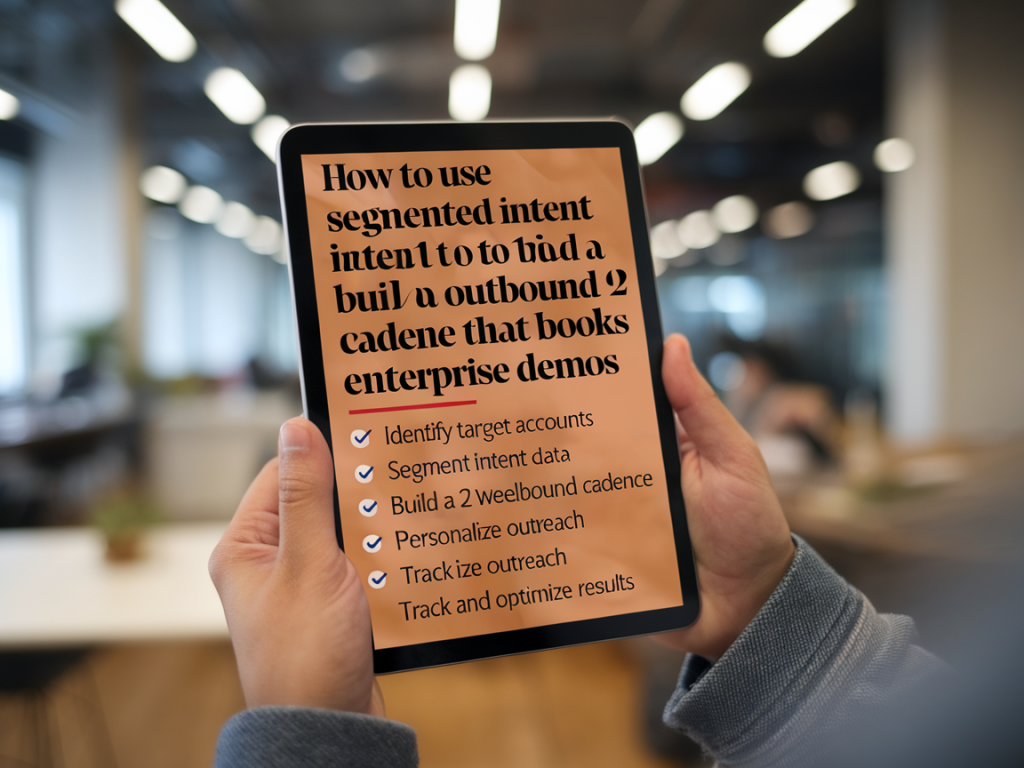
I build outbound systems that actually book enterprise demos — not just spray-and-pray cadences that waste reps’ time. One of the most reliable levers I've used is segmented intent data: combining topic-level signals with firmographic fit to target accounts that are actively researching solutions like yours. Below I walk through a pragmatic, 2-week outbound cadence that uses intent segments, channel sequencing and copy examples you can drop into Outreach, Salesloft or HubSpot sequences.
Why segmented intent beats generic lists
Intent data on its own is noisy. A large vendor, a competitor blog, or a conference sponsorship can spike signals across thousands of accounts. Segmentation is how you turn intent into a predictable pipeline:
When you target accounts that match the topic + fit + recent velocity criteria, outbound response rates climb and demos are higher quality.
How I build intent segments
I use a mix of providers and first-party signals depending on budget: Bombora, 6sense and G2 for topic intent; LinkedIn Sales Navigator and Clearbit for firmographics; our website analytics and Pardot/HubSpot for first-party signals. My steps are:
Output: several prioritized account lists (A / B / C) with contact roles and intent score.
Two-week outbound cadence — structure and rationale
Two weeks is short but sufficient to get a response if you’re targeted and timely. The cadence below uses email, LinkedIn and a single call attempt per account, focused on value and relevance rather than pitching features. Aim for 6 touches max across channels.
| Day | Channel | Action | Goal |
|---|---|---|---|
| Day 0 | Email 1 | Personalized intent opener + value proposition + CTA for a 20-min demo | Secure response / book demo |
| Day 2 | LinkedIn Connect & Message | Short note referencing intent topic and content/resource | Awareness + social proof |
| Day 4 | Call 1 | Voicemail if no answer: reference intent signal and offer 20-min call | Create urgency / touchpoint |
| Day 7 | Email 2 | Case study + specific outcome that matches their segment | Build credibility |
| Day 10 | LinkedIn Content + DM | Share a relevant short article or data point; tag them if appropriate | Top-of-mind and social validation |
| Day 13 | Email 3 (Breakup) | Direct question + easy way to accept/decline; one-click calendar link | Final opportunity to convert or close out |
Copy templates — personalize for intent
Below are short templates I use. Replace bracketed bits with intent and account information.
Email 1 — Intent opener
Hi [FirstName],
I noticed [Company] has been researching [intent topic] recently — we see that pattern when teams are trying to reduce [specific pain]. At [YourCompany] we helped [similar company] cut [metric] by [X%] in 12 weeks. Do you have 20 minutes next week to see how this maps to your plans? [CalendarLink]
Email 2 — Case study follow-up
Hi [FirstName],
A quick example: [ClientName] (in [Industry]) was struggling with [pain]. After a 4-week pilot focused on [outcome], they saw [metric improvement]. I’ve attached a short one-pager — would you like the same playbook applied to [Company]?
LinkedIn connect message
Hi [FirstName], I saw [Company] reading about [intent topic]. I share short posts on how teams reduce [pain]. Happy to connect.
Voicemail script
Hi [FirstName], this is [YourName] from [YourCompany]. We’ve helped teams tackling [intent topic] reduce [pain]. I’ll send a short note with an example — would love 20 minutes if it’s relevant. My calendar is [link].
Breakup email
Hi [FirstName],
I don’t want to clog your inbox. If [intent topic] isn’t a priority, say the word and I’ll stop reaching out. If it is, one quick call is all I’m asking for: [CalendarLink]
Execution tips that improve conversion
KPIs and what “good” looks like
Because the accounts are intent-qualified, your expectations should be higher than cold outbound:
Track time-to-response, demo-to-close conversion, and the average deal size from intent-sourced accounts vs non-intent sourced. These will justify spend on intent providers.
Common pitfalls and how I avoid them
In practice, I’ve used this approach to double demo conversion rates in campaigns where reps previously averaged 1–2 demos per week. The mechanics are straightforward: identify meaningful intent, pair it with fit, move quickly and craft messaging that ties intent to a tangible outcome. If you want, I can share a downloadable sequence for Outreach (subject lines, email bodies, timing) tailored for your product category — tell me your vertical and target account size and I’ll adapt it.